The crunch problem: why baklava bites are becoming the dessert industry’s most versatile inclusion
Ask a product development team what usually breaks first in a dessert concept, and the answer is rarely flavour. Flavour is solvable. You can adjust, mask, boost, or reformulate your way to a profile everyone in the tasting room agrees on.
Texture is where launches quietly fail.
A concept tastes exactly right on the bench, then spends six weeks in a freezer or three months on a shelf and arrives at the consumer as something softer, duller and less interesting than what was signed off. The crunch is gone. And with it goes the one sensory cue that made the product feel worth its price.
Crunch is the last hard problem in dessert development. It is also, right now, the most commercially valuable one to solve.
Why crunch is so difficult to keep
Every crunchy inclusion is in a losing fight with its surroundings.
Moisture migration is the main culprit. Put a dry, porous piece into a system with higher water activity — ice cream base, mousse, cream filling, custard — and physics does the rest. Water moves toward the dry piece until equilibrium is reached. Biscuit softens. Wafer collapses. Cereal turns to paste.
Freeze-thaw cycling makes it worse. Ice crystals form, melt and re-form during distribution and in the consumer’s own freezer, and each cycle drives more moisture into whatever structure is available.
Thermal processing removes the option of solving it late. Anything that needs to survive a bake, a pasteurisation step or a tempering cycle has to be built for it.
The industry’s usual answers are all compromises: coat the inclusion in fat and accept the cost, use a denser and harder piece and accept the mouthfeel penalty, or accept a shorter crunch window and manage it with packaging and shelf-life claims.
Which is why a piece that holds its bite structurally, rather than through a coating, is worth a closer look.
What baklava bites actually are
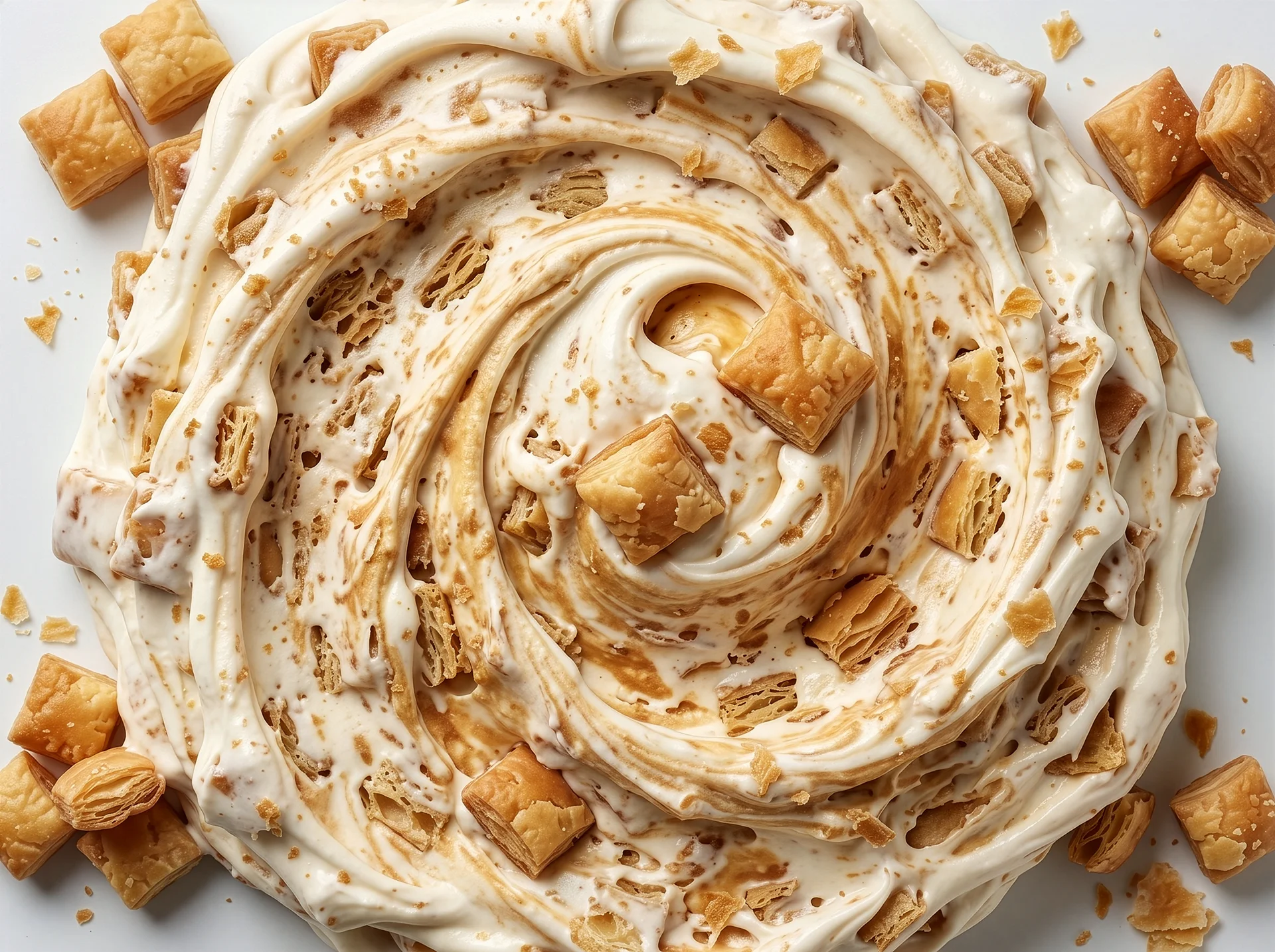
Bite-Sized Crispy Baklava are whole miniature baklava — individual, bite-sized squares of multi-layered pastry, made from thinly sheeted dough and baked until dry and golden. Not a crumb, not a crumble, not a fragment of something larger: each one is a complete little baklava.
The interesting part is the architecture. This is not a solid biscuit or a dense chip — each bite is many extremely thin layers with air between them, baked through. Two things follow from that structure.
First, residual moisture is low and the bite has already been driven past the point where it can lose much more. Second, the crunch is distributed across dozens of thin laminations rather than concentrated in one dense mass. That is why the eating experience is a light, shattering crispness rather than the hard, tooth-packing snap of a biscuit inclusion — and why it keeps performing in fat-based systems and frozen applications where softer-structured inclusions give up.
In practice, this is what our customers report back: the bites hold their crunch in ice cream and in fat-based fillings, in applications where they had previously been unable to keep texture past the first few weeks.
Where they work
The reason baklava bites are showing up in so many different briefs is that they are not a single-application ingredient.
Ice cream and frozen desserts
The most demanding test, and the one that matters most commercially. As an inclusion, a ripple component, a cone or stick-bar coating, or a layer in a multipack tub, the bites give frozen products a textural contrast that survives distribution — the thing consumers notice immediately and repeat-purchase for.
Cream-based and set desserts
Crème caramel, panna cotta, mousse cups, layered desserts, pudding pots. These formats are almost entirely smooth, which makes them comforting but sensorially flat. A crisp, golden pastry element on top or folded through changes the eating experience completely, without changing the flavour identity of the dessert.
Toppings and decoration
This is where the bites earn their place fastest. They are irregular, golden and visibly layered — they photograph as handmade rather than manufactured. On a cheesecake rim, a gelato display, a plated dessert or a café signature item, they deliver a premium visual cue at industrial cost and with zero preparation.
Chocolate and confectionery
Filled bars, pralines, truffles, spreads and inclusion chocolate. The current wave of texture-led confectionery has proven the consumer appetite for a crunchy element suspended in a smooth one, and baklava bites sit naturally in that category.
Bakery and patisserie
Tart and cheesecake bases, croissant and pastry fillings, layered gateaux, viennoiserie finishing. Applications where a texture element is wanted but a second baking step is not.
Straight snacking
The simplest application, and the one most people overlook. The product is already a finished, edible sweet on its own. In a retail pack, a foodservice portion, a hotel amenity or a private label snack range, it needs no development work at all — it needs a bag.
Two crunches in one dessert
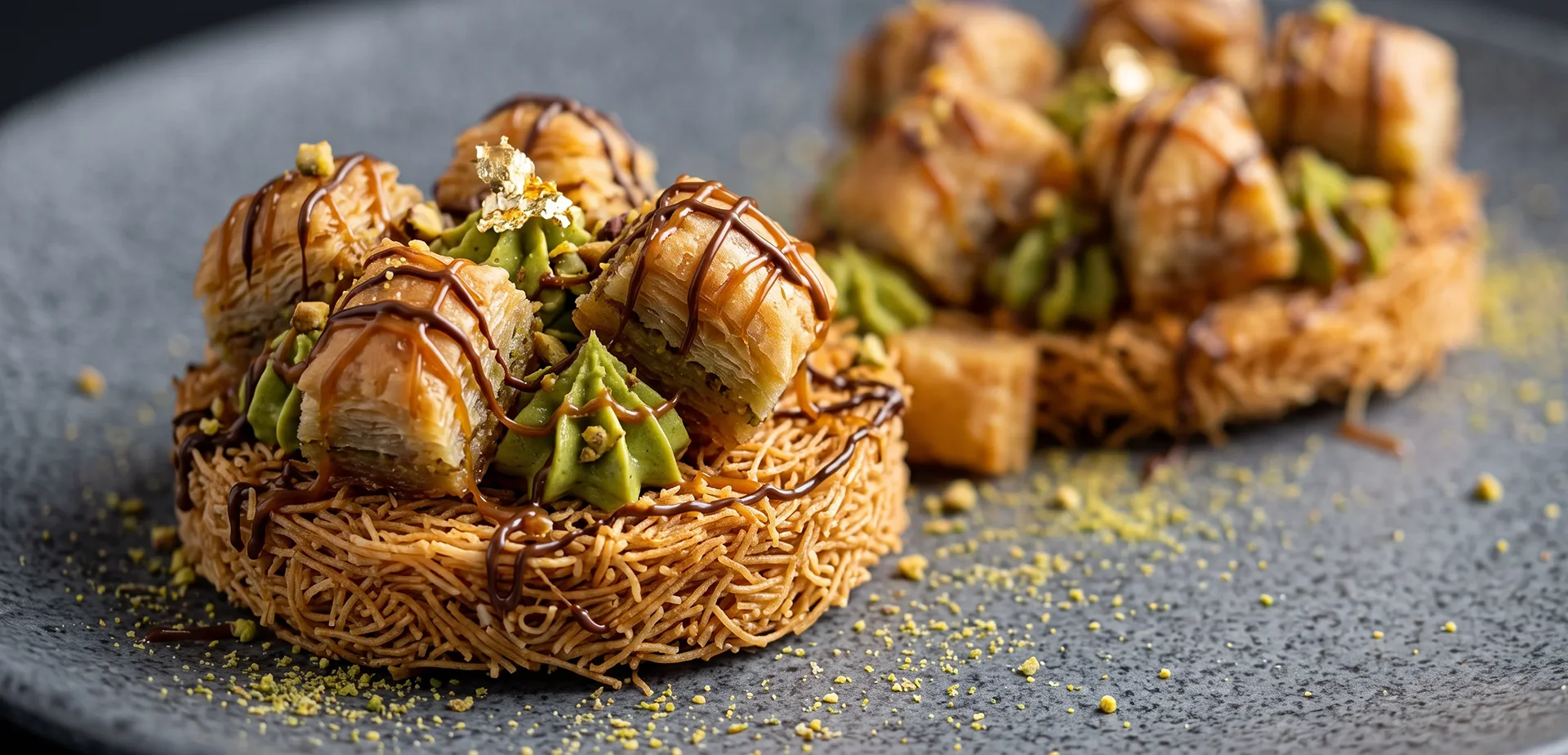
One of the more interesting things we see on customer benches is the bites being specified alongside Crispy Kadayıf — roasted shredded kadayıf — rather than instead of it.
The two crunch in completely different ways. Crispy Kadayıf is fine and hair-like — it forms a nest or a base, browns beautifully, and gives a light, fibrous crispness that spreads across the whole bite. Baklava bites are whole and visibly laminated — they sit on top as individual little baklava and shatter rather than crumble.
Put them in the same dessert with a smooth element between them, as in the composition above, and you get three separate textural moments in a single spoonful, with a visual build that photographs extremely well. For premium retail desserts, patisserie and hotel dessert programmes, that combination does a lot of work for very little formulation effort — both components arrive baked, dry and ready to assemble.
Why they are easy to bring into production
Sensory performance only matters if the ingredient is workable. Three things make these straightforward to adopt.
They arrive finished. Baked and ready to use. No proofing, frying, syruping, toasting or baking step on your line. Dose, fold or sprinkle — that is the whole integration.
They are ambient and dry. No thawing, no cold-chain handling, no rehydration. They store and move like a dry ingredient, which keeps them out of your freezer capacity and your defrost schedule.
They behave consistently. Piece size and moisture are held stable batch to batch, which is what makes them dose evenly and give the same coverage and mouthfeel from one production run to the next. For an NPD team, predictability across runs is worth as much as performance in the first trial.
Notes for product developers
A few practical points from applications work:
- Add late, with minimum shear. Like any laminated structure, the bites will fracture under sustained mixing. Introduce them at the last possible stage.
- Consider a fat barrier for high-water systems. In the wettest applications, a thin chocolate or cocoa butter coating extends the crunch window considerably. In fat-based systems it is usually unnecessary.
- Remember you are working with whole pieces. Each bite is a complete miniature baklava, not a crumb or a crumble. That is where the visual value sits — the layered edge is visible on the plate, and it is what makes the product read as handmade. Design the format around showing the piece rather than dispersing it.
- Trial the flavour as a base note, not a top note. The profile is baked pastry — warm, buttery, lightly caramelised. It sits underneath a dessert’s dominant flavour rather than competing with it, which is why it works across pistachio, chocolate, vanilla, caramel and fruit systems alike.
Why now
Three things have converged.
Texture has become a claim. “Crunchy” now appears on front-of-pack in categories where five years ago it would have been a formulation detail. Consumers have learned to look for it, and to pay for it.
Middle Eastern and Turkish dessert profiles have gone mainstream in Europe. The pistachio-and-crispy-kadayıf wave that began with Dubai chocolate and swept the confectionery category over the last two years proved that these flavours are no longer regional specialities — they are commercial mainstream, and the demand outran supply almost immediately.
Baklava needs no explanation. This is quietly the most valuable point. Most novel ingredients cost you consumer education. Baklava does not. The word already carries meaning, quality association and desirability across every European market. You are not introducing an unknown — you are giving a familiar name a new format.
Getting started
Bite-Sized Crispy Baklava are available ready to use, from industrial bulk through to retail-ready private label packaging.
For European customers, we ship from our warehouse in the Netherlands with orders from a single pallet, or direct from Türkiye for full-container volumes. EXW and DAP terms are available, fully customs-cleared, and samples ship from Europe within days — so a trial can be on your bench next week rather than next quarter.